
(Part 5 of the PERMA Series)
In this series, we’ve been exploring how things like engagement and relationships are the lifeblood of sustainable growth — and how creating a high-performance sales culture depends on activating both. Most companies are sitting on a goldmine of dormant contacts and internal signals they’re not acting on.
But there’s an even deeper layer we need to talk about now.
A quieter force that determines whether people actually stay in motion long enough to make all this work stick.
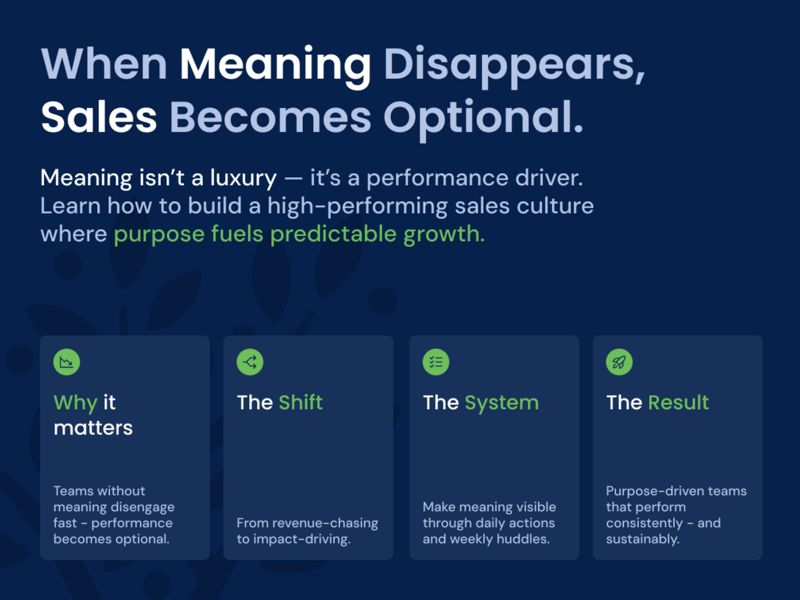
That force is meaning, and it’s the sense that “what I’m doing matters, and I matter while doing it.”
And when meaning is present your people move with clarity, energy, and pride.
When it’s absent? They go through the motions… until they eventually check out altogether.
And in today’s economy where every team member is wearing multiple hats, meaning isn’t a luxury. It’s a performance driver.
Now here’s the uncomfortable part:
Most companies talk about KPIs, deadlines, and objectives…
But they rarely talk about why the work is worth doing in the first place.
Especially in customer-facing roles.
Salespeople are told to hit their numbers.
CSRs are told to be “efficient.”
Ops teams are told to deliver on scope.
But who’s telling them:
- “Your confidence and boldness is driving the growth of our business.”
- “Your proactivity creates trust no software can replicate.”
- “You’re the reason our client renewed. Your perseverance made all the difference.”
Most people have no idea how much impact they’re actually making because no one’s showing them.
And when people lose sight of the “why,” everything becomes harder:
- Outreach feels like obligation instead of opportunity.
- Rejection stings more because there’s no deeper purpose to anchor into.
- Collaboration weakens because the goal becomes “just finish the task,” not “make a difference.”
It’s a subtle erosion of morale… and momentum.
And eventually, people burn out, not from the workload, but from the emptiness.
The moment your team forgets why the work matters is the moment performance becomes optional.
Meaning is the anchor. It’s what holds engagement in place when results lag, when deals stall, and when the daily grind wears on.
And yet most companies don’t have a system to communicate meaning consistently.
The good news? You don’t need a motivational speaker or a mission statement refresh.
You just need a way to make impact visible again.
Imagine “meaningful work” not just as a buzzword, but a daily source of fuel for your customer-facing team.
It’s simpler than you think. And it changes everything.
How Meaning Creates a High-Performance Sales Culture That Can’t Be Stopped
Here’s a hard truth that most leaders eventually learn the painful way:
You can give your team the best script, CRM, and incentives on earth…
But if they don’t believe the work matters, they won’t sustain the effort.
Because belief beats tactics every time.
And that’s why, when companies infuse their business development culture with meaning, their teams go from going through the motions… to moving mountains.
Let’s start with what this actually looks like.
Picture a company where:
- A customer service rep says, “I followed up today because I know it helps our clients feel seen, not just served.”
- A project manager makes a referral handoff because “this customer trusts me, and I want to make sure they keep winning.”
- A salesperson celebrates a colleague’s swing in a Monday huddle by saying, “That conversation might’ve saved a $1M relationship.”
That’s not fluff. That’s emotional alignment.
That’s the invisible thread that turns action into momentum.
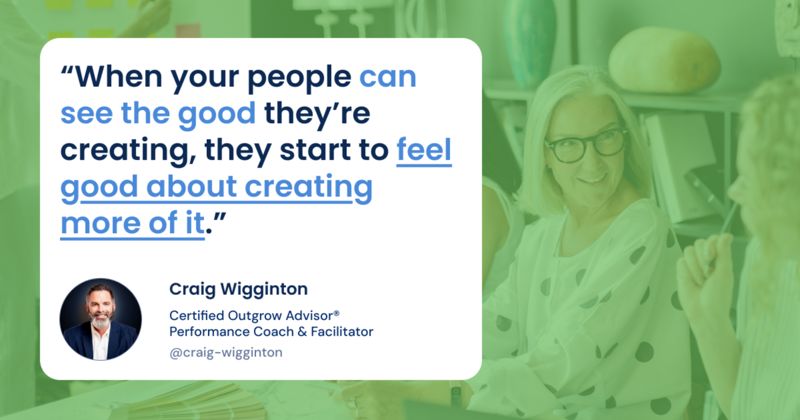
When your people can see the good they’re creating, they start to feel good about creating more of it.
And that’s the unlock.
This is what positive psychology has told us for decades, that meaning amplifies motivation, buffers against burnout, creating a high-performance sales culture that’s sustainable. PERMA isn’t theoretical. It’s operational. And “M” – Meaning – might be the most underestimated force in business development.
So how do you make meaning show up in a sales culture?
It starts with a fundamental reframe:
Instead of asking “How do we close more deals?”
Start asking, “How do we help more people today?”
That’s the shift. From revenue-chasing… to impact-driving.
Once you adopt that lens, everything changes:
- Outreach becomes an act of service, not a transaction.
- Cross-functional collaboration becomes purpose-driven, not politically motivated.
- Even rejection becomes bearable because it’s not personal… it’s just part of the process of helping more people.
And guess what?
When meaning is present, performance becomes exponential.
Why? Because your team stops holding back.
They swing more.
They follow up more.
They share more opportunities across functions.
Not because they’re told to. But because they want to.
They feel like part of something bigger than themselves.
And that’s what makes a culture unstoppable.
In companies using the Outgrow system, we see this shift happen fast:
- In a wealth management firm, one advisor said, “I used to think my job ended at solving problems. Now I see myself as someone who drives client retention by showing up proactively.”
- In a distribution business, an inside sales rep started proactively asking, “What else do you have coming up that we can help you with?” That one habit led to millions in new business.
That’s not about charisma. That’s about meaning.
And you don’t need to “motivate” people to do this.
You just need to show them how much impact they’re already making.
That’s what we’ll unpack next: the Outgrow process for operationalizing meaning without adding overhead.
Because when you build a system that reflects your people’s value back to them daily…they rise. Every time.
The Meaning Loop: How Outgrow Builds Purpose Into Every Customer Touch
Let’s get practical.
You want your team to feel like what they do matters not just to you, but to your customers, to the business, and to each other.
But meaning isn’t something you can shout into existence at a quarterly all-hands.
It has to be built into the rhythm of the work.
And that’s what the Outgrow system delivers: a repeatable, visible, reinforcing loop that reminds your team why they matter. Every single week.
Here’s how it works:
Step 1: Start With the Evidence — Real Feedback from Real Customers
You can’t manufacture meaning. But you can surface it.
And the easiest way to do that is by mining for moments when customers have said:
- “Thank you! This made my life easier.”
- “We couldn’t have pulled that off without you.”
- “I tell people about your team all the time.”
Outgrow helps your leadership team and front-line staff learn from and marinate in this positive feedback.
And once you start sharing it, the culture starts shifting:
- Sales reps are reminded that clients like hearing from them.
- Service folks feel the emotional payoff of their responsiveness.
- Ops teams start to realize, “They’re not just buying product — they’re buying us.”
Meaning starts flowing back into the day-to-day.
Step 2: Reflect Impact Back to the Team — Publicly and Often
During each weekly Outgrow Huddle, we carve out time for success stories:
“Where did you make a difference last week?”
This isn’t about ego. It’s about identity reinforcement.
When a sales rep says, “I followed up on an old client, and they were grateful just to hear from us,” that’s meaning.
When a field tech says, “I mentioned a service we hadn’t talked about before, and they asked for pricing,” that’s meaning.
And when those moments get shared aloud in front of peers, the emotional ROI becomes real.
You’re not just logging calls. You’re changing the customer experience for the better.
Step 3: Align Swings With Service — Helpfulness Over Hustle
Each swing (a proactive action) is framed in Outgrow not as a pitch, but as a helping act.
This makes a massive difference.
Your team isn’t cold-calling. They’re:
- Consistently asking what else customers need help with.
- Systematically educating customers on solutions they believe would genuinely help.
- Showing up when no one else does.
Because when outreach is rooted in service, it feels good to do.
And when something feels good, your people want to do it again.
That’s how meaning becomes habit.
Step 4: Use Language That Reflects Identity, Not Just Output
Here’s a leadership secret: the words you use shape what people believe about their work.
That’s why in Outgrow, we encourage CEOs and managers to say things like:
- “You showed up – and that matters.”
- “You persevered and that strengthened the relationship.”
- “You’re not just servicing our customers, you’re driving retention and lifetime value.”
When your team starts hearing these cues – consistently – they begin to internalize the mission.
Now they’re not just “doing a job.”
They’re contributing to something meaningful.
Your customer-facing team performs at their best not when they feel pressure, but when they feel purpose
That’s the positive feedback loop we build:
→ Take helpful action.
→ See the impact.
→ Feel good about it.
→ Do it again.
It doesn’t require a culture overhaul.
Just a process that makes emotional progress visible, not just financial results.
Purpose-Driven Sales Isn’t a Fantasy — It’s a System (Let’s Build Yours)
When you think about what it takes to grow your business, what’s your first instinct?
More leads? More salespeople? More hustle?
Those things can help, but they’re not what actually drives long-term, culture-wide growth.
That comes from something deeper.
Something more durable.
Something most companies overlook:
Meaning.
If your customer-facing people wake up every day believing:
- “I help our clients succeed.”
- “My work protects relationships and creates value.”
- “What I do actually matters…”
Then outreach becomes natural.
Follow-up becomes consistent.
And sales becomes shared, not siloed.
But if they don’t believe those things?
If they feel like just another cog, chasing just another number?
Then even the best strategy, the most advanced CRM, or the most charismatic sales leader won’t make a difference.
Because you can’t scale indifference.
But you can scale belief.
The companies that grow the fastest, retain the best talent, and deliver the best client experiences aren’t just operationally excellent, they’re emotionally aligned around a shared sense of purpose and have mastered creating a high-performance sales culture rooted in meaning and purpose.
And the good news?
That’s not reserved for unicorns or Fortune 500s.
It’s available to you — right now — with a simple system that embeds meaning into the rhythm of the business.
That’s what the Outgrow system is built to do.
It helps your team:
- See the positive impact they’re already making.
- Celebrate it in front of each other.
- Build on it every single day through small, helpful actions.
And when that happens?
Culture shifts.
Confidence rises.
Performance follows.
Your people stop waiting for motivation.
They start moving from meaning… the strongest fuel there is.
Culture isn’t what you talk about. It’s what your people feel when they take action, and whether they believe that action matters.
So here’s your moment:
Let’s have a conversation.
If you’ve been nodding along, if you’ve been seeing the gaps – and the potential – in your own team… now’s the time to take the next step.
Let’s talk through your current culture, your growth goals, and how Outgrow can help you infuse purpose into every customer touchpoint.
It doesn’t take a re-org. It doesn’t take new hires.
It takes a system that shows your people just how valuable they already are.
And once they see it?
They won’t stop showing up.
This article is the fifth article in our PERMA series, where we explore how Positive Psychology principles fuel the Outgrow system to transform sales cultures and drive predictable growth. Explore the full series:
- Why Most Business Development Efforts Are Broken
- Why Low Morale Is Quietly Killing Your Sales — And What to Do About It
- Why Disengaged Employees Sabotage Sales, Even if They Don’t Mean To
- The Real Reason You’re Missing Sales? You Stopped Talking to the Right People
- When Meaning Disappears, Sales Becomes Optional (And That’s a Big Problem)
- Why Your Team Isn’t Winning More (Even When They’re Working Hard)