
(Part 4 of the PERMA Series)
In our last article, we unpacked how engagement — not effort — is the secret to consistent sales growth. When your people are emotionally bought in and activated daily, you see more outreach, more momentum, and more wins.
But now we need to get even more specific. Because all the swings in the world won’t matter if they’re not directed toward the right people. That’s where a relational sales approach changes everything.
Here’s what I see again and again in growth-stalled organizations:
Your team is busy. Your team is competent.
But they’re disconnected from the relationships that matter most.
It’s not that they don’t care. It’s that your company has unintentionally normalized a rhythm that only touches a small portion of your customer base and leaves the rest to fade into the background.
Let’s put some numbers to it.
In most B2B companies:
- 10–20% of customers receive 80–90% of all outbound communication.
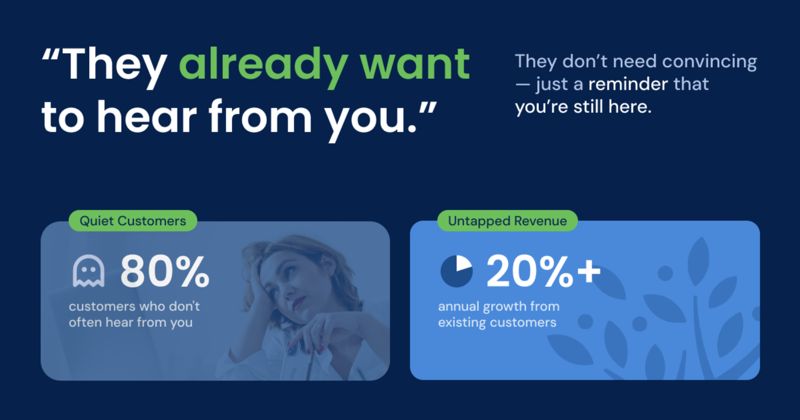
- A full 80–90% of customers go weeks or months — sometimes longer — without hearing from anyone.
- And cross-functional team members rarely share relational insights, referrals, or signals. Why? Because no one’s asking them to.
This is the relationship gap. And it’s costing you far more than you think.
Because relationships don’t just drive retention, they drive expansion:
- Referrals from warm relationships close 70% faster and at higher margins.
- Existing customers buy 20-50% more when someone shows up and asks the right question.
- Cross-functional awareness turns operations and service staff into lead generators, if they’re tuned into the “who.”
And yet… the average account manager or seller-doer is “talking” to maybe 10% of your book of business.
That means 90% of your customer relationships are underdeveloped, under-touched, and under-leveraged.
And when relationships sit idle, they degrade. Slowly. Quietly. Until you realize that someone you considered “loyal” just awarded a project to someone else… simply because that someone else stayed connected.
Worse still? Internally, your people aren’t sharing relationship signals across functions, because they’re working in silos.
How many opportunities has your ops or admin team heard on a call… and then let drift into nothingness?
How many new customer needs were spotted by a project manager… but never made it back to sales?
How many referrals sat unasked because “that’s not my department”?
The problem here isn’t lack of skill. It’s lack of a relational system.
Because just like engagement and emotion, you have to choreograph relationships, or they’ll default to chaos, inconsistency, and missed opportunity.
Now, let’s consider what it looks like when a business actually builds sales and service around relationships — not just transactions — and how that shift unlocks exponential growth without adding headcount.
How a Relational Sales Approach Unlocks Revenue Hiding in Plain Sight
Most businesses think they have a sales problem.
In reality, they have a relationship neglect problem.
Because if you’re like most SMBs, your team isn’t short on customers… they’re short on connection.
And when you shift your company culture to prioritize relationship-building over transaction-chasing, something remarkable happens:
Your existing customers start buying more.
Your internal teams start collaborating more.
Your referral pipeline opens up.
And your sales become more predictable — and less stressful.
Let’s zoom in.
Imagine a company where:
- A service technician wraps up a job and confidently asks, “Who else do you know that we can help like this?” That question uncovers a $60K project no one knew about.
- A project manager asks her GC, “What percent of your business do we have?” and discovers another $6M worth of work they can bid on.
- An engineer proactively calls three past clients in one day using a simple prompt: “Was working with another client who reminded me of you…” and uncovers two new projects.
This is what a relationship-first business development culture looks like.
It’s built on familiarity, trust, and intentional reconnection.
Here’s the kicker: you don’t need more cold leads.
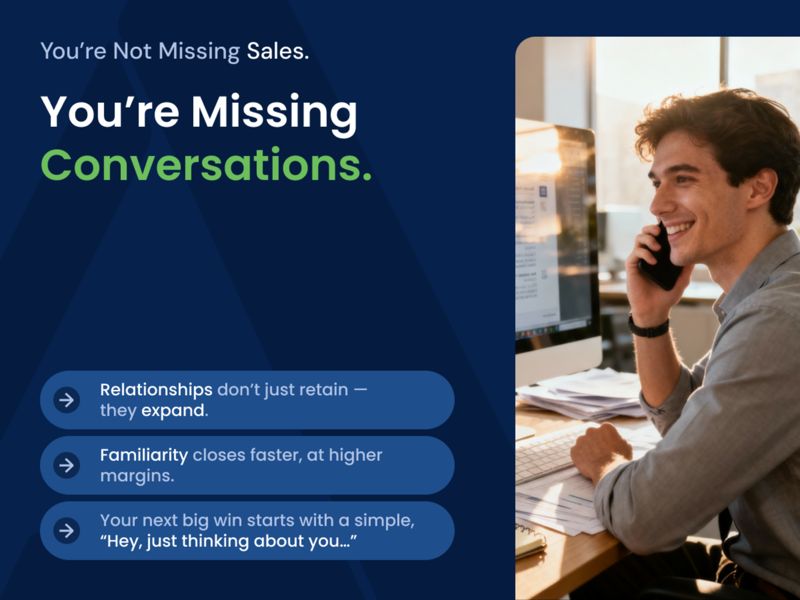
You need more conversations with people who already trust you.
Why?
Because choreographing proactive calls to the 80-90% of customers who love you (but never call you) has massive built-in advantages:
- Speed: Familiarity shortens the buying cycle.
- Margin: Trust reduces price sensitivity.
- Efficiency: You’re not educating from scratch, you’re building on shared history.
While most companies spend thousands trying to generate cold leads, the smart ones turn their attention inward to the relational goldmine already sitting inside their customer base.
But let’s be clear: this doesn’t happen by accident.
It happens when you intentionally build a system that:
- Prompts your team to reach out regularly.
- Shows them how to reconnect in a helpful, human way.
- Makes relational handoffs easy and expected, not awkward or rare.
That’s where most companies fall short. They treat relationship-building like a personality trait (“Jeff’s good with people”) instead of a cultural practice that can be taught, tracked, and scaled.
When you change that mindset, everything changes.
Sales stops being isolated.
Ops stops being reactive.
Service stops being just order-takers.
And everyone becomes a connector — to value, to opportunity, and to each other.
Here’s a secret: in high-performing Outgrow companies, it’s not the most extroverted people driving growth… it’s the most intentional:
- A CSR who makes five proactive calls a week.
- An engineer who asked three clients this week “what else” they need help with.
- A sales rep who logged 7 pivots this week and opened up $250k in new opportunities.
Relationships aren’t soft.
They’re strategic.
They’re the infrastructure that supports sustainable, predictable growth.
And Outgrow makes those relationships visible, actionable, and systematized — across every function in your business.
The Relationship Operating System: How Outgrow Reconnects Your Whole Business
Most companies don’t lose deals because of bad products or poor service.
They lose deals because they fade from memory.
They drift. They go quiet. They fail to reappear when it matters most.
And that happens not because your people don’t care but because they don’t have a system for staying in relationship.
Here’s what the Outgrow process does differently: it turns relationships into a trackable, team-wide operating system.
Let’s break it down.
Step 1: Map Your “Quiet 80%”
Every company has them: customers who are satisfied, maybe even loyal… but not actively engaged. They haven’t been called. Haven’t been asked. Haven’t heard from you unless there was an invoice or a problem.
That’s your Quiet 80%, and it’s the biggest opportunity you’re missing in your business.
Outgrow starts by helping you identify and prioritize these relationships:
- Past customers you haven’t spoken to in 6 months.
- Current clients only using one of your services.
- Prospects who were interested but never bought.
We help you build a relational call list; one that doesn’t rely on cold leads, but reconnects with people who already trust you.
That alone starts to generate momentum.
Step 2: Systematize Helpful Reconnection (3–5 Swings Per Day)
Once those relationships are identified, Outgrow trains your team to reach out simply and naturally.
We’re not asking them to pitch.
We’re asking them to show up and be both human and helpful.
Here’s what a swing might sound like:
- “Hey, it’s been a bit since we last connected. How are you? How’s your family?”
- “Just thinking about your project from earlier this year. How’s that going? What else do you have coming up that we can help you with?”
- “Did you know we provide XYZ? Would that be useful for you?”
These aren’t cold calls. They’re warm reconnections. And when your whole team does 3–5 a day, the compound effect is massive.
Step 3: Build the Cross-Functional Loop
Here’s where Outgrow really changes the game.
We don’t just focus on salespeople. We activate your entire customer-facing org from service, operations, and field teams, to show up more consistently, together.
During Monday Huddles, those actions get choreographed in a positive and visible way.
Your team starts to realize: “We’re growing this company together.”
And your customers? They feel the difference.
Step 4: Celebrate the Connectors
In a relationship-first culture, effort is the hero.
That means we celebrate:
- The service rep who proactively calls when nothing is wrong.
- The engineer who asks “What else are you working on that we can help you with?”.
- The sales rep who consistently pivots to the next step.
Outgrow reinforces this weekly by showcasing not just wins, but effort.
This creates a feedback loop: people keep doing what gets recognized. So the relationship engine doesn’t just start. It sustains.
If you want to build a revenue machine, first build a relationship machine.
That’s what the Outgrow system delivers.
Your people reconnect.
Your customers respond.
Your pipeline fills, not from pressure, but from proximity.
Your Next Big Win Is in a Conversation You Haven’t Had Yet — Let’s Fix That
Here’s the truth: you’re probably only one or two conversations away from your next six-figure opportunity.
It’s sitting inside your book of business. It’s known. It’s familiar. It’s trusted.
But if your team doesn’t reach out, it stays buried.
And if you don’t have a system that encourages and celebrates those connections, it stays buried forever.
And the key to unlocking it isn’t another campaign or sales push — it’s a relational sales approach that keeps your team consistently connected to the people who already trust you.
That’s the difference between companies that grow predictably… and companies that grow accidentally.
One’s built on a proactive, relationship-first culture.
The other’s built on reactive growth.
So what would it look like if your business was systematically reconnecting with the right people, every single day?
Let’s paint that picture:
- Your team starts each week with clarity about who to reach out to; not cold leads, but warm relationships where we show up to be helpful.
- Every customer-facing role sees themselves as part of the growth effort, not just a task executor.
- You hear team members saying things like, “I called a client we hadn’t heard from in 6 months, asked what they had coming up that we could help with and surfaced a $150k opportunity.”
- You’re not guessing where growth will come from. You’re surfacing it through conversation.
That’s what a relationship operating system delivers.
It’s not just about being “friendly” or “good with people.”
It’s about building revenue through rhythm.
It’s about turning fragmented, reactive communication into coordinated, proactive outreach.
And it’s about showing your team how incredibly valuable they are — not just to you, but to the customers who already believe in them.
That’s the work. And it’s joyful work.
Because when your team starts hearing things like:
- “Thanks for the call! No one else does that anymore.”
- “You saved us a ton of time by thinking ahead.”
- “Actually, I was just about to reach out to you…”
…they don’t need to be pushed to keep selling.
They want to.
And that’s what Outgrow installs. A culture where relationship-building is normalized, celebrated, and measurably tied to growth.
You’re not reaching out to strangers. You’re reconnecting with people who already want to hear from you. They just need a reason, and a rhythm.
So here’s my invitation to you:
Let’s schedule a short, focused strategy conversation.
We’ll talk about your current customer touchpoints, the hidden relationships you’re likely missing, and how Outgrow can help you activate all of it with structure, speed, and simplicity.
Because your next big win?
It’s already out there. It’s just waiting for someone on your team to pick up the phone and say, “Hey, I was just thinking about you…”
This article is the fourth article in our PERMA series, where we explore how Positive Psychology principles fuel the Outgrow system to transform sales cultures and drive predictable growth. Explore the full series:
- Why Most Business Development Efforts Are Broken
- Why Low Morale Is Quietly Killing Your Sales — And What to Do About It
- Why Disengaged Employees Sabotage Sales, Even if They Don’t Mean To
- The Real Reason You’re Missing Sales? You Stopped Talking to the Right People
- When Meaning Disappears, Sales Becomes Optional (And That’s a Big Problem)
- Why Your Team Isn’t Winning More (Even When They’re Working Hard)